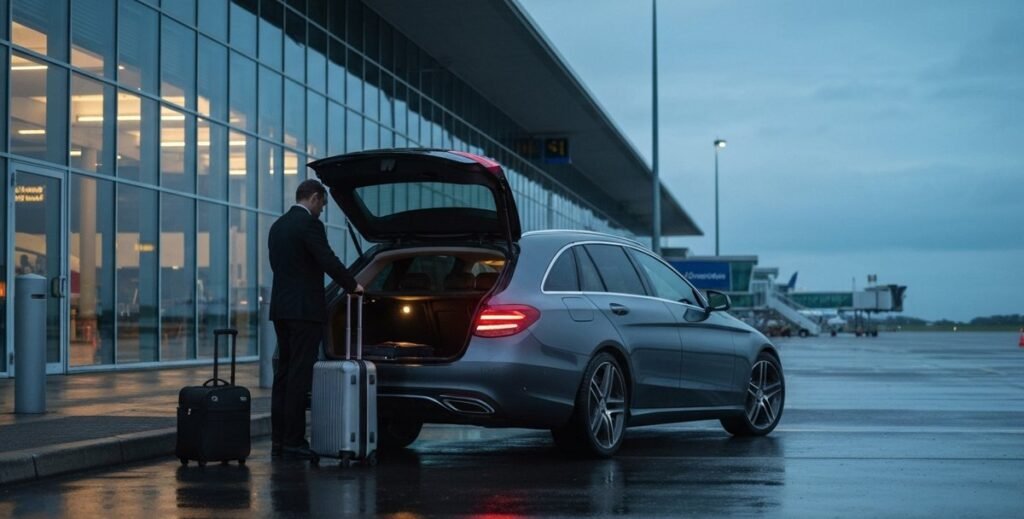
The fastest door-to-door option from Dublin Airport to Belfast is a pre-booked private transfer, covering roughly 165 km via the M1 and A1 in approximately 1 hour 45 minutes to 2 hours. The Aircoach 705X coach takes around two hours direct to Belfast Grand Central Station, no city-centre transfer required. Taking the Enterprise cross-border train is comfortable but requires a separate trip from the airport into Dublin Connolly Station first, putting total journey time at around three hours.
Getting from Dublin Airport to Belfast is a well-travelled run — about 165 kilometres of motorway that crosses a land border, changes speed-limit signs from kilometres to miles per hour, and arrives in a city that runs on a different currency. None of those things are real obstacles if you know what to expect, but they do make the Belfast route different from other cross-country transfers out of Dublin Airport.
This guide covers the three main options: coach, train and pre-booked private transfer. For each one you will find where to board, what the journey looks like, and what can trip you up.
Here is how the options stack up for total door-to-door travel time from the terminal:
A pre-booked private transfer departs directly from T1 or T2 and goes to your door in Belfast, with no fixed timetable to catch.
1. Aircoach 705X — The Direct Coach
The Aircoach 705X is the most straightforward public transport option for Belfast from the airport. It runs from both terminals at Dublin Airport directly to Belfast Grand Central Station — no transfer into Dublin city centre required.
Where to board:
- Terminal 1: Zone 2
- Terminal 2: Zone 20
Journey time: Approximately two hours in normal traffic. Aircoach runs up to 34 services daily on the 705X, spread across the full 24 hours. The first departure from Dublin City Centre is at 00:50, meaning services exist even for late or delayed flights — check the live timetable at aircoach.ie before you travel.
Where it drops you: Belfast Grand Central Station on Grosvenor Road — Belfast’s main transport hub since it opened in October 2024, replacing the former Europa Bus Centre at Great Victoria Street. From Grand Central you are a five-minute walk from the heart of the city. The Victoria Square shopping centre, City Hall and the Cathedral Quarter are all within easy walking distance or a short taxi ride.
Fare: Aircoach accepts onboard contactless payment (Visa, Mastercard, Apple Pay and Google Pay), but online booking secures the best price. Discounts: 20% for young persons aged 14–21 booked online; 10% family discount for two adults travelling with children; children under 3 free.
Luggage: Standard coach rules — one piece of hold luggage up to 20 kg plus a small carry-on item per passenger. Golf clubs or oversized baggage may incur an extra charge or be refused if the bus is full. Contact Aircoach before you travel if you are bringing equipment.
What to watch for: The 705X serves both Belfast and Derry-Londonderry on the same route — Belfast passengers disembark at Grand Central, the coach continues north. On busy summer days or bank holiday weekends, seats fill quickly. Book online in advance rather than turning up at Zone 2 hoping for a walk-up seat.
A second coach operator worth knowing about is Dublin Express, which also runs services from Dublin Airport directly to Belfast Grand Central. Worth comparing schedules at dublinexpress.ie if the 705X timing does not suit your flight.
2. The Enterprise Train
The Enterprise is the cross-border intercity service operated jointly by Irish Rail and Translink NI. It is the most comfortable option on this corridor — generous seats, onboard catering and space for luggage — but it requires a step that the 705X does not: getting from Dublin Airport into Dublin city centre first.
Dublin Airport has no rail station. To board the Enterprise you must travel from the terminal into Dublin Connolly Station. The most direct route is a coach service from both airport terminals to Connolly (Dublin Express Route 784X runs this connection). A street taxi is the faster alternative at off-peak times. Budget 30 to 45 minutes for this transfer, plus time to allow for the connection.
Dublin Connolly → Belfast Grand Central: The Enterprise takes approximately 2 hours and 8 minutes. Services run Monday to Saturday at roughly hourly intervals — 15 departures per day in each direction, from 05:50 to 20:50. On Sundays, eight services operate. If your flight arrives after roughly 19:00, getting to Connolly in time for the last train will be tight once you add the transfer from the airport.
Booking: Advance singles are cheaper than walk-up tickets on both sides of the border — book ahead on irishrail.ie (Dublin side) or translink.co.uk (Belfast side). First class is available on most services.
Passport and border crossing: Irish and British citizens travel freely under the Common Travel Area (CTA) — there is no passport control or customs queue on board. Citizens of other countries cross an international border between the Republic of Ireland (EU) and Northern Ireland (UK) and should carry their passport, though there is no physical checkpoint on the train.
Total door-to-door time from Dublin Airport: Once you add the airport-to-Connolly transfer, connection time and any check-in buffer, realistic total time from the terminal to Belfast is around three hours. The train makes most sense if you are already in Dublin city centre. From the airport itself, the Aircoach 705X is a more direct option.
3. Pre-Booked Private Transfer
For passengers travelling with family, heavy luggage, sporting equipment, or business clients, a pre-booked fixed-fare private transfer is the most practical option on the Belfast route. It is also the only one that handles the cross-border jurisdiction question neatly.
Journey time: Approximately 1 hour 45 minutes to 2 hours 15 minutes from Dublin Airport to a Belfast city-centre address, depending on traffic on the M50 approach to the airport and the Newry-to-Belfast section of the A1 in Northern Ireland.
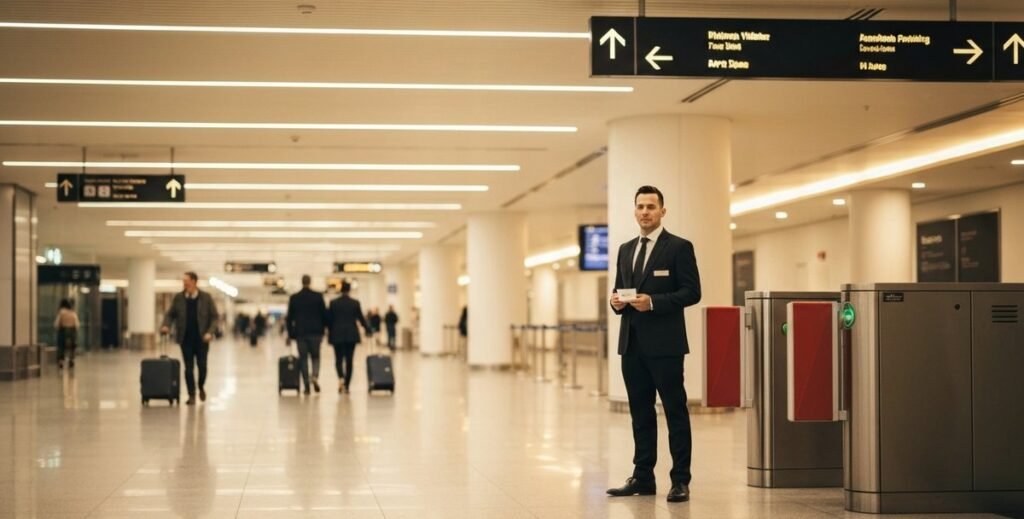
How it works: Your driver monitors your flight, waits in the arrivals hall at T1 or T2 with a name board, and takes you directly to your door in Belfast. One agreed price confirmed before you travel — no timetable to catch, no luggage limit, no currency exchange needed for the journey itself.
The cross-border advantage: Pre-booked transfers operate on a fixed-fare arrangement agreed before departure, which sidesteps the metered-taxi jurisdiction issue covered in the section below. Your price is confirmed in advance; there are no surprises at the Northern Ireland frontier.
Irish Ride is a Dublin Airport-based SPSV-licensed operator providing long-distance outward transfers. We do not operate a local taxi rank in Belfast itself.
Travelling to Belfast from Dublin Airport?
Fixed price, flight-tracked, driver in arrivals with a name board. No meter, no timetable stress, no currency guesswork on the journey.
The Route: M1, the Border and the A1
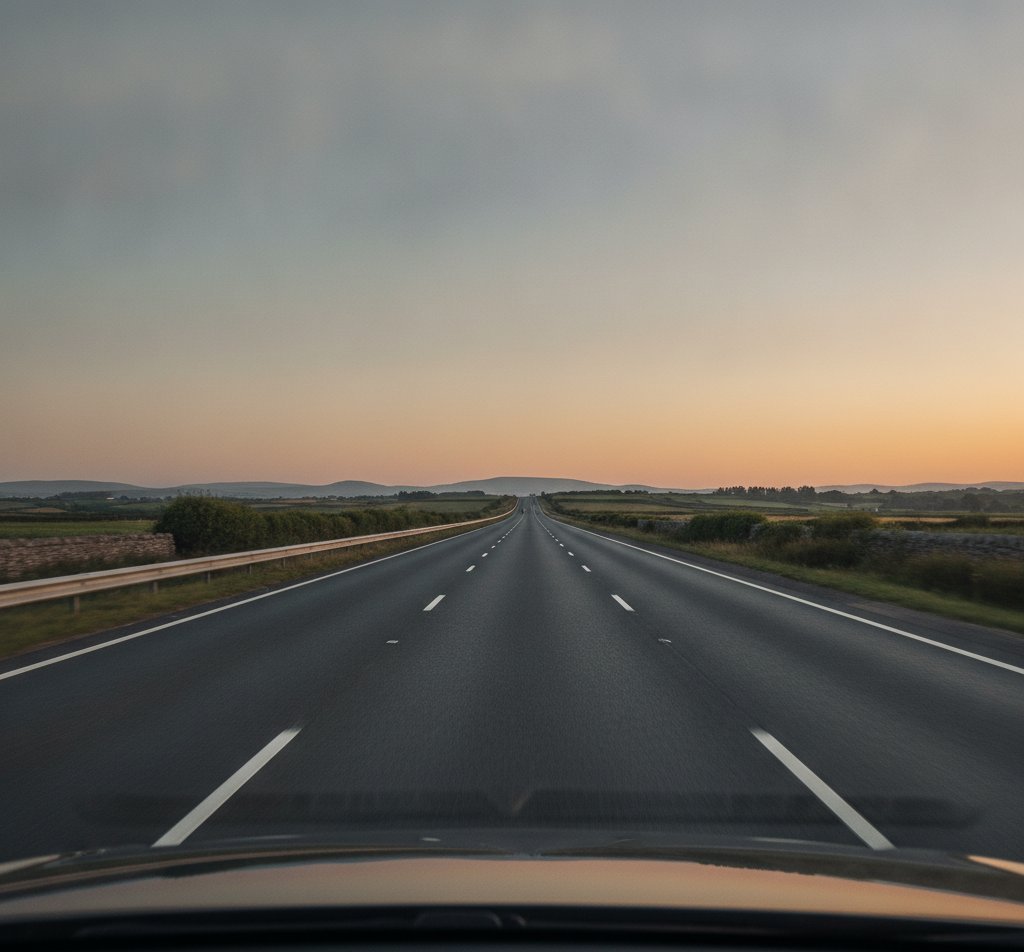
The drive from Dublin Airport to Belfast is unusually simple in terms of navigation. From the airport you join the M50 ring road heading north, pick up the M1 motorway, and follow it all the way to the border. On the Northern Ireland side the road continues as the A1 dual carriageway into Belfast. One motorway, two names, one continuous road.
Tolls you will encounter:
The M50 near Dublin Airport is a barrier-free electronic toll — no barriers, no cash booth. It has to be paid online via eflow.ie by 8pm the following day. Hire-car drivers frequently arrive home to a penalty notice because they did not know this toll existed. If you are in a rental car, check whether eFlow payment is included in your rental package.
Approximately 50 km north of Dublin, the M1 passes through the Drogheda bypass tolls (Gormanston to Monasterboice, Junctions 7–10) — a traditional toll plaza with barriers. Cash and card accepted.
There are no tolls anywhere in Northern Ireland.
The border: There is no physical checkpoint between the Republic of Ireland and Northern Ireland. Traffic flows freely. What changes immediately on the Northern Ireland side is the road signage. Speed limits in the Republic are in kilometres per hour (motorway maximum 120 km/h). Across the border they switch to miles per hour (dual carriageway and motorway maximum 70 mph, approximately 113 km/h). If you are driving a hire car and your speedometer shows mph, you are fine. If it shows km/h only, be aware that 70 mph is the limit and adjust accordingly.
Traffic pinch points: The M50 near the airport can back up heavily during morning peak (07:00–09:00) and evening peak (16:30–19:00). The Newry approaches on the A1 — where the dual carriageway narrows through the town — slow periodically. The M1 NI into Belfast city centre is the other common delay point during commuter hours.
Currency and Practicalities Once You Arrive
Northern Ireland uses Pound Sterling (GBP, £). Euros are not accepted at most businesses; some tourist-facing venues will take them at an unfavourable rate, but card payment is the practical option for visitors coming from the Republic.
Northern Ireland banks issue their own sterling notes — Bank of Ireland NI, Ulster Bank, Danske Bank. These are fully valid throughout Northern Ireland. Card payment (Visa, Mastercard) is accepted almost everywhere.
Taxis at Belfast Grand Central: The new Grand Central Station, which opened in October 2024 on Grosvenor Road, has a modest public-hire rank outside. App-based taxis — Bolt and Uber both have Belfast coverage — are the more reliable option for immediate onward travel from the station.
The Anti-Pattern: Do Not Hail a Metered Rank Taxi at Dublin Airport for Belfast
This is worth stating directly because it catches people out.
National Transport Authority (NTA) licensed street taxis at Dublin Airport operate under the NTA’s metered tariff framework, which applies within the Republic of Ireland. Northern Ireland is a separate legal jurisdiction, regulated by the Driver and Vehicle Agency NI (DVA NI). An NTA metered rate does not map to a 165-kilometre cross-border journey.
Beyond the jurisdictional question, running a meter for 165 km — plus the dead-leg return journey — is a significant commitment for a rank driver. Many will decline the fare outright. Those who accept will often name an informal figure at the window, with nothing in writing and no recourse if the number changes.
If you want a private car to Belfast, book it in advance with a fixed price confirmed in writing before you travel. That applies whether you use Irish Ride or any other operator. Our long-distance fare guide covers the wider context of how pre-booked transfers work differently from metered taxis on routes of this length.
Summary Comparison
| Feature | Private Transfer | Aircoach 705X | Enterprise Train |
|---|---|---|---|
| Departs from airport terminal | ✅ | ✅ | ❌ (transfer to Connolly) |
| No city-centre detour | ✅ | ✅ | ❌ |
| Door-to-door to your address | ✅ | ❌ | ❌ |
| Works with delayed flights | ✅ | Partly — 24/7 service | ❌ — fixed timetable |
| Fixed price before you travel | ✅ | ✅ (online booking) | ✅ (advance booking) |
| Flexible luggage | ✅ | ❌ | ✅ |
| Baby / child seats available | ✅ | ❌ | ❌ |
| Wi-Fi / onboard catering | — | ✅ | ✅ |
For a broader overview of how long-distance transfers out of Dublin Airport work — and how the Belfast route compares to Cork, Galway and Killarney — see our Dublin Airport long-distance fare and time guide, or the wider Ireland airport transfers guide covering Dublin, Cork, Shannon and Knock. For everything about the airport itself — terminals, pickup zones, and what to expect on arrival — the Dublin Airport arrivals guide and T1 vs T2 pickup guide cover those in full.
Ready to book your Belfast transfer?
Get a fixed all-in price for Dublin Airport to Belfast. Flight tracked, meet and greet in arrivals, no meter surprises.
Frequently Asked Questions
Is there a direct bus from Dublin Airport to Belfast?
Yes. Aircoach 705X runs non-stop from Terminal 1 (Zone 2) and Terminal 2 (Zone 20) to Belfast Grand Central Station in approximately two hours. No transfer into Dublin city centre is needed. Book online at aircoach.ie. Dublin Express also runs on this route — compare timetables at dublinexpress.ie.
Is there a direct train from Dublin Airport to Belfast?
No. Dublin Airport has no train station. To take the Enterprise cross-border service you must first travel from the airport to Dublin Connolly Station (approximately 30–45 minutes by bus or taxi), then board the train to Belfast Grand Central. Total door-to-door time from the airport is around three hours.
Do I need a passport to go from Dublin to Belfast?
Irish and British citizens do not need a passport — the Common Travel Area (CTA) means the two jurisdictions are treated as a single travel zone. Nationals of other countries cross an international border and should carry a passport, though there is no physical checkpoint or customs queue on board the train or at the road frontier.
What currency is used in Belfast?
Northern Ireland uses Pound Sterling (GBP, £). Euros are not generally accepted. Card payment (Visa or Mastercard) is the simplest approach for visitors from the Republic. Exchange euros to sterling before you travel, or use a card with no foreign-transaction fee.
Can a Dublin Airport taxi take me to Belfast?
A pre-booked fixed-fare private transfer from a licensed operator is the correct way to travel. Never hail a metered rank taxi at Dublin Airport for Belfast — the NTA metered tariff applies within the Republic only, and rank drivers may refuse a 165-km cross-border fare or quote an unconfirmed price. A pre-booked transfer with a confirmed fixed price avoids all of this.
How long does it take to drive from Dublin Airport to Belfast?
Roughly 1 hour 45 minutes to 2 hours 15 minutes in normal traffic, covering approximately 165 km via the M1 motorway (Republic) and the A1 dual carriageway (Northern Ireland). Add extra time during morning and evening peak hours on the M50 near the airport and on the Belfast approaches.
Are there tolls on the road from Dublin Airport to Belfast?
Two toll points: the M50 near Dublin Airport (paid online via eflow.ie — no cash booth) and the M1 Drogheda bypass (cash or card at the barrier). There are no road tolls in Northern Ireland. A pre-booked private transfer has every toll built into the fixed price agreed before you travel.