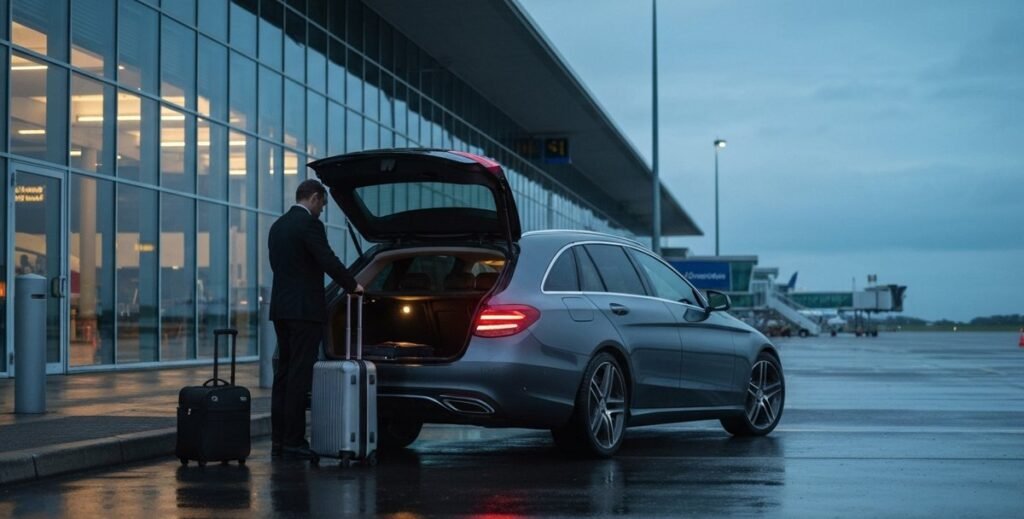
A standard metered taxi from Dublin Airport (DUB) to the city centre is priced on the National Transport Authority’s regulated meter, which changes rate depending on the time of day, plus an M50 toll if the driver crosses J6–J7. Aircoach 700, Dublin Express and the Dublin Bus 16 all run the route too, each at their own fixed ticket price. A pre-booked private chauffeur transfer with Irish Ride is a single fixed fare agreed before you travel, so it does not change with traffic, time of day, or how the M50 is moving.
That is the headline. The honest answer to “what will it actually cost me?” depends on when you land, how many people you are, how much luggage you have, and whether you want certainty or surprise. The rest of this guide walks through every option and what drives the price on each, so you can choose what works for you.
Want a fixed fare, no meter surprise?
Pre-book a private Dublin Airport transfer with a licensed Irish driver. Flight tracked. No tolls or surcharges added.
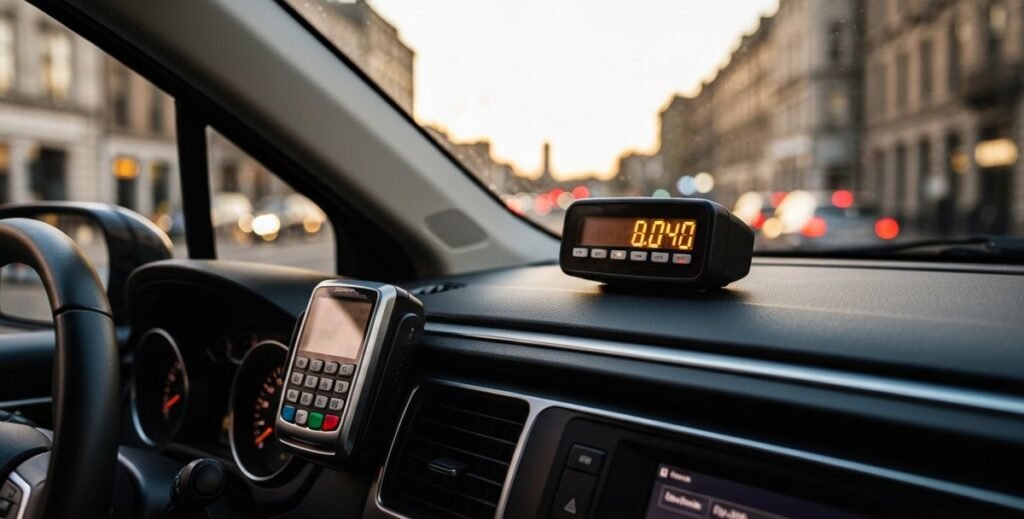
How the Dublin taxi meter actually works
Every licensed taxi in Ireland runs on a regulated meter set by the National Transport Authority. The current rates have been in force since 01 December 2024 under Statutory Instrument No. 479 of 2024. There are three tariff bands, called Standard, Premium and Special.
| Tariff | When it applies |
|---|---|
| Standard | Monday to Saturday, 08:00–20:00 |
| Premium | Mon–Sat 20:00–08:00, all Sunday, most bank holidays |
| Special | 00:00–04:00 Fri / Sat / Sun, Christmas Eve to St Stephen’s Day, NYE to NYD |
The driver does not choose the tariff. The meter detects the clock and applies the right band automatically, and each band also charges more per kilometre and per minute stationary than the one before it. What this means in practice is that a flight landing at 22:30 on a Tuesday will cost noticeably more than the same trip at 14:00, even on the same route, and the only thing that has changed is the law.
Why the same trip can price differently on two different days
The Terminal 2 to Temple Bar run is about 17.5 km and 25–45 minutes depending on traffic. The final number on the meter is built from four things stacking on top of each other: the tariff band your landing time falls into, the distance charge for those 17.5 km, a time charge for any slow-moving traffic, and the M50 toll if the driver crosses it. Land at 14:00 on a Tuesday and you are on the cheapest band with a clean run. Land at 23:00 the same day, or in the 00:00–04:00 weekend Special window, and every one of those four elements moves against you at once — the tariff is higher, and delays cost more per minute stationary.
Friday-evening Port Tunnel traffic, an East Wall diversion, or a Croke Park match day adds further waiting-time charges on top. Hailing a metered taxi at the rank means you do not know the final number until you arrive.
The M50 toll — who pays?
The M50 motorway between Dublin Airport and the city centre passes the eFlow toll point at junction 6–7. Taxi drivers will route via the M50 only if it is the fastest option (often it is not, between 16:00 and 19:00). When they do, the toll is passed on to the passenger — it is added to the metered fare.
Pre-booked private transfers from a chauffeur company are different: at Irish Ride we absorb the M50 toll inside the fixed quote, so what you see at booking is exactly what you pay. No surprise toll line at drop-off.
Bus, coach and rail — the cheaper options
Three public-transport routes leave Dublin Airport for the city centre. Each makes sense for a different traveller.
| Option | Frequency | Journey time | First / last service | Drops you at |
|---|---|---|---|---|
| Aircoach 700 | Every 15 min, 24/7 | 20–40 min | 24-hour | Drumcondra, O’Connell St, Trinity, St Stephen’s Green, Ballsbridge |
| Dublin Express 782 / 784 | Every 15–20 min | 30–40 min | 04:30 to 00:30 | O’Connell St, Custom House, Westmoreland St |
| Dublin Bus Route 16 (Leap card) | Every 15–20 min | 60–80 min | 05:00 to 23:30 | Drumcondra, O’Connell Bridge, Rathmines, Terenure |
Aircoach is the closest thing to a chauffeured experience on a public-transport budget: every 15 minutes around the clock, runs even when other services do not. Booking online in advance is cheaper than paying on board. Boarding points and night frequencies in the next section. Source: Aircoach Route 700.
Dublin Express is functionally similar, with slightly better central-city drop-off points if you are staying around Trinity or Westmoreland Street.
Dublin Bus 16 is the lowest-cost of the three — but only if you have a Leap Card rather than tapping a bank card at the door. The 90-minute TFI fare lets you transfer onto any other Dublin Bus or Luas tram within that window at no extra cost. The trade-off is journey time: 60–80 minutes vs 25 minutes in a car.
The DART suburban rail does not serve Dublin Airport directly. You would need to bus to Howth Junction first, which defeats the point. There is no train at the airport.
Aircoach 700 — boarding points and schedule
The 700 is the coach most travellers end up on. Booking on the Aircoach website a few days ahead is cheaper than paying the walk-up price on board. Under-4s travel free on a lap, and tickets are flexible: valid on any 700 departure within 12 hours either side of the one you booked.
Where to board. At Terminal 1 the stop is at Zone 2 — straight out the arrivals door and across the pedestrian crossing. At Terminal 2 it is Zone 20 — through the atrium at arrivals and down the escalator on your left. Both are signposted from inside the terminal.
Night service. The 700 runs 24 hours a day, every day except Christmas Day — every 15 minutes through the day and evening, easing to every 30 minutes between midnight and 04:00. It is the only public-transport option for a 02:00 arrival, and unlike a taxi meter the fare does not change at night.
Luggage and payment. Two hold bags (up to 20 kg each) plus a soft carry-on travel free per passenger. Pay contactless on board, or book ahead on the website or app.
One thing worth weighing before you join the queue: for a family or a group of three or four with cases, a pre-booked private transfer is door-to-door with no per-person ticket to add up — no drag from the coach stop to the hotel either.
Pre-booked private transfer — when does it make sense?
Picking between a fixed-fare private transfer and a metered rank taxi is mostly about certainty, group size and arrival time.
Choose a rank taxi when:
- You are travelling solo or with one other person, with carry-on only
- You land between 09:00 and 17:00 on a weekday
- The rank queue at T1 or T2 is moving (it usually is — Dublin Airport keeps both ranks well-staffed)
- You are happy to read the meter
Choose a pre-booked private transfer when:
- You are 3+ passengers with checked luggage and want one vehicle
- You land between 23:00 and 06:00 (every minute on a meter is the premium or special rate)
- It is your first time in Dublin, late at night, in winter
- You need a child seat and want to be sure it is in the car before you arrive
- You want flight tracking — if the flight is delayed two hours, the driver knows, you do not need to call
- You want the M50 toll, tip and any waiting time inside the price you agreed at booking
Get a fixed quote in 30 seconds
Tell us your flight and your Dublin address. We come back with a single all-inclusive number — no meter, no toll surcharges, no surprises.
Card or cash?
Every licensed taxi in Ireland has been required to accept cashless payments since 01 September 2022 under the NTA’s Cashless Payments rules. What that means at Dublin Airport:
- All ranks at T1 and T2 are staffed by licensed Small Public Service Vehicles (SPSVs).
- Every car at the rank has a contactless terminal — Visa, Mastercard, American Express, Apple Pay and Google Pay are universal.
- Drivers cannot legally refuse a card payment, full stop — the NTA has fined drivers who tried to insist on cash or claimed a broken machine.
- You can split the fare across multiple cards if you ask.
- A tip prompt may appear on the card terminal. Tipping is optional in Ireland — round up the fare or add €2–€5 for luggage help. There is no expectation of 15–20 % as you would see in North America. We covered this in detail in our taxi tipping guide.
Where are the ranks, exactly?
If you walk out of arrivals expecting an Uber pickup zone, you will be at a Dublin standstill for a while. Dublin Airport operates official taxi ranks at both terminals — they are signposted and queue-marshalled.
- Terminal 1: leave Arrivals through Door 1 or Door 2, walk straight ahead — the rank is at Zone 1 on the kerb opposite arrivals.
- Terminal 2: leave Arrivals at Level 0, the rank is directly outside Door A.
There is no surcharge or “airport fee” added at the rank — the fare is the meter fare, full stop. We wrote a full Dublin Airport arrivals walk-through covering everything between the door of the plane and the door of your hotel.
For the wider picture on Dublin, Cork, Shannon and Knock transfers, see our Ireland airport transfers guide.
Turning your transfer into a day trip
If your airport transfer is the first leg of a longer day exploring Ireland, our private day trips are below. Same logic — one car, one driver, one fixed price agreed up front.

Featured day trip
Cliffs of Moher Private Day Tour
Featured day trip
Giant’s Causeway & Antrim Coast
Frequently Asked Questions
Does a taxi cost more from Dublin Airport at night?
Yes. Between 20:00 and 08:00 the meter switches to the Premium tariff, and between 00:00 and 04:00 on Friday, Saturday and Sunday the Special tariff applies — both charge more per kilometre and per minute stationary than the daytime rate, before the M50 toll is even added if the driver uses the motorway. A pre-booked private transfer costs the same fixed price no matter what time you land.
Is the M50 toll included in the taxi fare?
No. Drivers add the eFlow toll to the meter when they use the M50. Pre-booked private chauffeur transfers from a licensed operator like Irish Ride include the toll in the fixed quote you agree at booking.
Can I take a Dublin Bus from the airport with a credit card?
Dublin Bus accepts contactless on its newer fleet, but paying with a Leap Card on Bus 16 works out cheaper than tapping a bank card at the door. Buy a Leap card from a vending machine at arrivals or use the TFI Go app.
Is there a train from Dublin Airport to the city centre?
No. There is no rail station at Dublin Airport. The DART (suburban rail) serves Howth Junction and Connolly, but you would need to bus there first. MetroLink — the proposed underground line to the airport — had its Railway Order become operative in January 2026 and is now in procurement, but there’s still no confirmed opening date; realistic estimates put it in the mid-to-late 2030s.
What’s the cheapest way from Dublin Airport to the city centre?
Dublin Bus Route 16 with a Leap card is the lowest-cost public option. The trade-off is a 60–80 minute journey and a transfer point at Drumcondra for many central-city hotels.
What’s the fastest way from Dublin Airport to the city centre?
A taxi from the rank or a pre-booked private transfer, both 20–25 minutes outside rush hour. Aircoach 700 is close — 20–40 minutes — and it runs every 15 minutes around the clock.
How do I book the Aircoach from Dublin Airport?
Book online in advance for the better fare, or pay contactless on board. Under-4s travel free on a lap. The coach leaves from Zone 2 at Terminal 1 and Zone 20 at Terminal 2, every 15 minutes.
Does the Aircoach run at night?
Yes. The 700 runs 24 hours a day, every day except Christmas Day — every 15 minutes during the day and every 30 minutes between midnight and 04:00. The fare doesn’t change at night, unlike a taxi meter.
Can I pre-book a fixed-fare taxi from Dublin Airport?
Yes. A licensed private hire transfer is one fixed all-inclusive price set at booking. The driver tracks your flight, meets you in arrivals with a name board, and the M50 toll and any waiting time are inside the quoted fare.
Done planning? Book your transfer.
Licensed Irish drivers, fixed all-in price, flight tracked. No signup. 24/7.