Driving in Ireland is manageable for most first-time visitors once past the first hour — left-hand traffic and constant roundabouts are the real adjustment, not the roads themselves. It gets genuinely harder in Dublin city traffic and on narrow rural roads after dark. What most driving guides skip is what changed recently, and when it’s smarter to just book a driver instead.
That’s the practical gap this guide fills: not another list of roundabout etiquette, but what actually changed in the rules this year, what rental companies don’t volunteer at the counter, and the honest math on when driving yourself costs more — in money or in nerves — than just booking a driver.
Quick answers
- Is it hard to drive in Ireland? Manageable for most people after the first hour, hardest in city traffic and on narrow rural roads after dark.
- What side do they drive on? The left, same as the UK.
- How long can a foreign licence be used? Up to 12 months for a non-EU/EEA licence; indefinitely for a valid EU/EEA one, per the Road Safety Authority.
- Did the speed limits change recently? Yes — rural local roads dropped from 80km/h to 60km/h in February 2025, with urban limits following by 2027. Several older guides still quote the old numbers.
If you’re only driving between the airport and the city, or you’d rather not think about any of this after a long-haul flight, that’s what the rest of this guide is for too — not just the rules, but when it’s genuinely easier to hand the driving to someone else.
Skip the rental counter entirely
Pre-book an Irish Ride transfer from Dublin Airport. Licensed driver, fixed price, no left-hand-traffic learning curve required.
The rules that actually trip people up
Ireland drives on the left, which is the single biggest adjustment for anyone arriving from North America, mainland Europe, or most of Asia. The practical effect shows up in small moments: reaching for the door instead of the gearstick, drifting toward the centre line on an empty road, misjudging a roundabout entry.
Roundabouts go clockwise here, and they’re everywhere — Ireland uses them in place of a lot of the traffic-light junctions you’d expect elsewhere. Yield to traffic already on the roundabout, from your right, and commit to your exit early; hesitating mid-roundabout is what causes most of the near-misses tourists report.
Seatbelts are compulsory in every seat, front and back. Handheld phone use while driving is illegal, same as most of the EU. And on rural roads — which make up the majority of Ireland’s network — expect single-lane sections with passing places, hedgerows right up against the tarmac, and the occasional herd of sheep with the right of way in practice if not on paper.
Can you actually drive here on your home licence?
Yes, with a time limit that depends on where your licence is from. Per the Road Safety Authority, a valid driving licence from any country outside the EU/EEA lets you drive in Ireland as a visitor for up to 12 months. If your licence was issued by an EU or EEA member state, there’s no visitor time limit at all — it’s valid for as long as the licence itself is.
Driving on an expired licence, or past that 12-month visitor window once you’ve become a resident, counts as driving without a valid licence under Irish law. For a short holiday this is rarely a real concern, but it’s worth checking your own licence’s expiry date before you fly, not after you’ve landed.
The speed limit changed in 2025 — a lot of guides still have the old numbers
This is the part most driving-in-Ireland articles get wrong simply because they were written before it happened. Under a road safety reform, the default speed limit on rural local roads — the small, unmarked-white-line roads that connect most of the countryside — dropped from 80km/h to 60km/h on 7 February 2025, covering roughly 82,000km of road nationwide. National secondary roads are the next category due to drop, to 80km/h. Urban cores, housing estates and roads near schools are being moved from 50km/h down to 30km/h in phases, with the target date for full rollout set at 31 March 2027.
Motorways stay at 120km/h and national primary roads at 100km/h — those weren’t part of this particular reform. It’s specifically the smaller local roads, the ones most tourists actually spend their time on once they leave a city, that changed. Watch for the new circular signs (a white disc with five diagonal black lines, paired with a plate reading “Go Mall / Slow”) — that’s the marker for the new 60km/h default.
(Source: Citizens Information — speed limit changes, RSA rural speed limit campaign.)
The rental-car trap nobody mentions until you’re at the counter
Automatic transmission is the exception in Ireland, not the default. Most rental fleets are manual by default, and renters who don’t explicitly request and pay extra for an automatic — sometimes weeks in advance, since the automatic fleet is smaller — can find themselves handed a manual car at the counter. If you’ve never driven stick, Ireland on your first attempt, on the wrong side of the road, is not the place to learn.
The other counter surprise is fuel. Petrol and diesel are sold by the litre, not the gallon, and pumps are self-serve with payment by a euro amount rather than “filling to the top” the way many US stations work. Outside the cities, stations thin out fast — it’s normal practice to fill up once a tank is around half empty rather than wait for it to run low on a rural route.
Dublin city driving and the M50
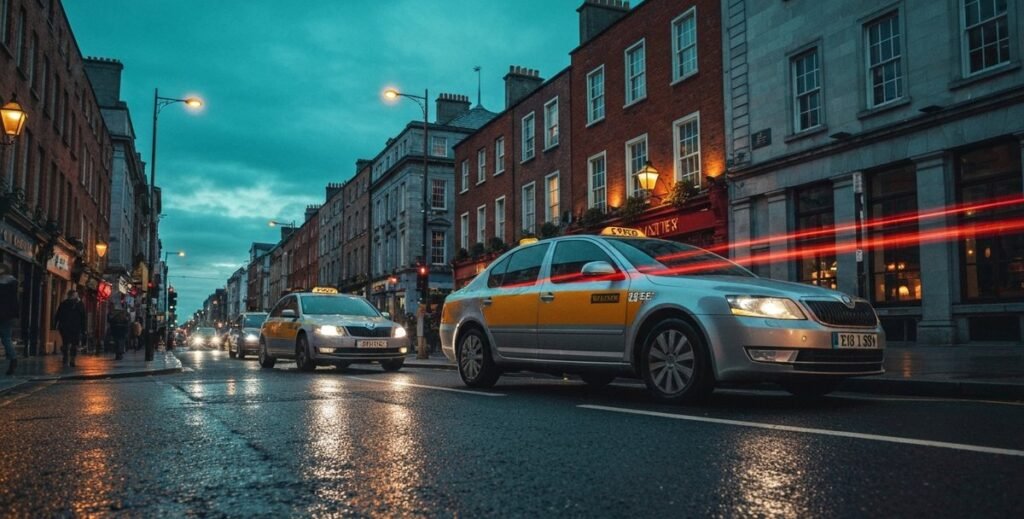
Driving within Dublin itself is a different exercise from the open road — bus lanes, box junctions, one-way systems around the city centre, and traffic that backs up hard at rush hour. The M50 ring road around the city carries a toll at the eFlow point between junctions 6 and 7; it’s charged automatically by number-plate recognition rather than at a barrier, and you have until 8pm the next day to pay online if you haven’t got a prepaid tag. We cover the full airport-to-city cost breakdown, tolls included, in Dublin Airport to City Centre Cost, part of the wider Ireland Airport Transfers picture.
Drink-driving limits are also stricter than some visitors expect: 50mg of alcohol per 100ml of blood for a standard licence, and just 20mg for anyone driving on a professional PSV/SPSV licence — both well under the 80mg limit UK visitors may be used to.
When it’s genuinely not worth driving yourself
None of the above is a reason to avoid driving in Ireland — plenty of visitors do it happily for a week-long road trip around the coast, and a self-driven Wild Atlantic Way run is a genuinely good reason to rent. For a single long day out instead, a private day trip with a driver who already knows the stops removes the same left-hand-traffic learning curve without committing to a multi-day rental. But there’s a specific, common scenario where self-driving is the wrong call rather than just the brave one: stepping off an overnight transatlantic flight, jet-lagged, straight into a rental car, on the opposite side of the road, in Dublin rush-hour traffic. Several driving guides quietly admit this themselves, suggesting nervous first-timers “practice outside the city” before attempting Dublin traffic — which isn’t really an option when the airport pickup is the first drive.
The other case is cost, once you count everything. A self-drive airport transfer isn’t just the rental rate — it’s the mandatory insurance excess, a full tank on return, city parking for however many nights you’re in Dublin before heading out to the country, and the rental desk’s own transfer time. A pre-booked private transfer replaces all of that with one fixed number agreed before you land.
| What matters | Self-drive from the airport | Pre-booked private transfer |
|---|---|---|
| Learning curve | Left-hand traffic, on arrival, jet-lagged | None — you’re a passenger |
| Price certainty | Rental rate + excess + fuel + parking, added up after the fact | One fixed price, agreed before you travel |
| Dublin city driving | Bus lanes, box junctions, one-way systems, rush hour | Not your problem |
| Best for | A multi-day road trip once you’re settled in | Airport arrival, groups, late-night landings |
Doing a road trip later in the week? Fair enough.
Plenty of guests rent a car for the open road but still book us for the airport leg — no reason to learn left-hand traffic in rush hour on zero sleep.
Frequently Asked Questions
Is it hard to drive in Ireland as a tourist?
Not especially, once past the first hour — the main adjustments are left-hand traffic and frequent roundabouts. It gets genuinely harder in Dublin city traffic and on narrow rural roads after dark, which is where most nervous first-timers struggle.
Can Americans drive in Ireland?
Yes. A valid US driving licence lets you drive in Ireland as a visitor for up to 12 months, per the Road Safety Authority. No Irish licence exchange is needed for a standard holiday.
Do I need an international driving permit for Ireland?
Not for a US, Canadian, or most other non-EU/EEA licences on a short visit — the standard home licence is sufficient for up to 12 months. Check your own country’s guidance if your licence isn’t printed in English, since some car rental firms ask for an IDP alongside it as their own policy, separate from the legal requirement.
What side of the road do they drive on in Ireland?
The left, with the steering wheel on the right side of the car — the same setup as the UK.
Did Ireland’s speed limits change recently?
Yes. Rural local roads dropped from 80km/h to 60km/h in February 2025. National secondary roads are next in line for a reduction, and urban areas are being phased down to 30km/h by March 2027. Motorways and national primary roads are unchanged at 120km/h and 100km/h.
Should I rent a car or book a transfer from Dublin Airport?
Depends on the trip. For a multi-day road trip around the country, renting makes sense. For the airport-to-city leg specifically — especially after a long flight or late at night — a pre-booked private transfer avoids the worst part of the learning curve at the worst possible time to be learning it.
Land, collect bags, get driven — no rental counter
Pre-book a fixed-fare private transfer with a licensed Irish driver. Flight tracked, toll included, no surprises at the end.