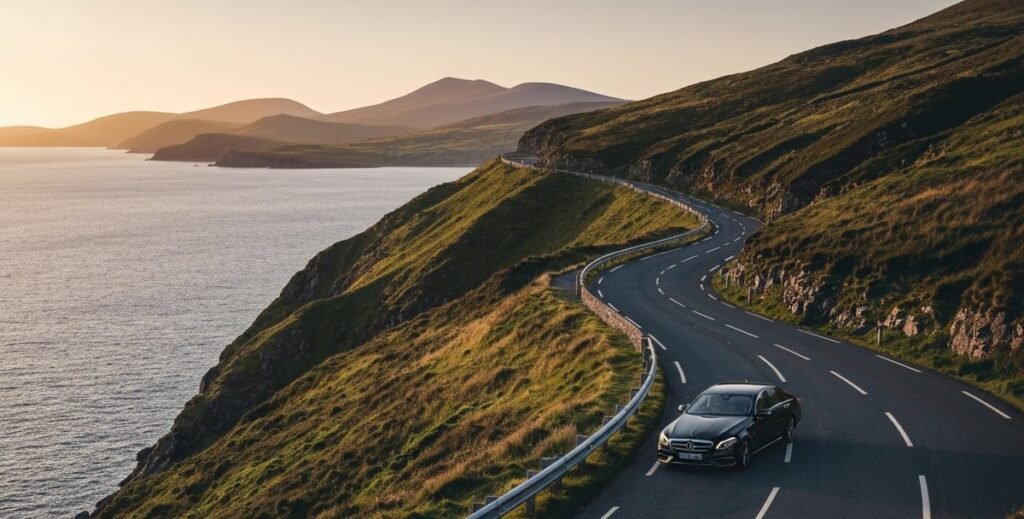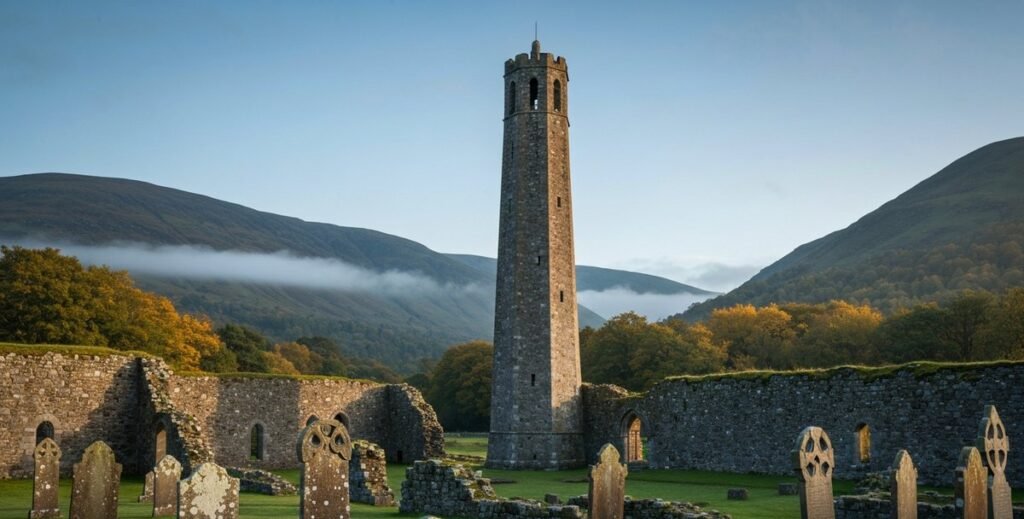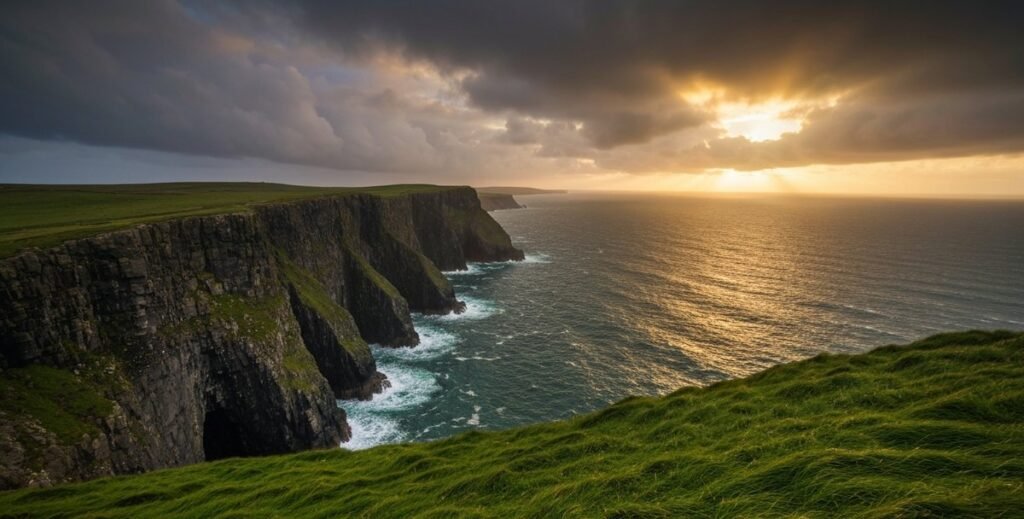
A Ring of Kerry tour from Dublin is one of Ireland’s great day trips — 179 kilometres of Atlantic coastline, mountain passes, stone villages and some of the most dramatic scenery on the island. It is a long day from Dublin, roughly 14 to 15 hours door to door, but it is entirely doable and worth every kilometre. The key to doing it well is leaving early, following the ring clockwise, and having someone else do the driving.
Quick answers
- Can you do the Ring of Kerry from Dublin in a day? Yes — depart Dublin at 6:30am, back by 9:30–10:00pm. Roughly 10 hours in Kerry.
- How far is the Ring of Kerry from Dublin? About 340km to Killarney. Allow 3h15m each way in normal traffic.
- Which direction should you drive? Clockwise. The Atlantic views open up on your left, and you avoid the tour coaches (they run counterclockwise).
- Best stop on the ring? Waterville for the beach and Charlie Chaplin statue. Kenmare for lunch. Bray Head if visibility is good — you can see Skellig Michael 12km offshore.
- Self-drive or private driver? Private driver. You are looking at 7 hours of driving, including narrow single-track roads. Having someone else handle it changes the entire day.
If you are arriving in Ireland from a country where day trips mean a two-hour drive each way, the Ring of Kerry will recalibrate your expectations — in the best way. The rest of this guide covers the full itinerary, stop-by-stop, and the honest trade-offs between your three transport options.
Ring of Kerry — private day trip from Dublin
Pickup from your Dublin hotel or Dublin Airport. One fixed price, driver included, no fuel or toll surprises.
How Far Is the Ring of Kerry from Dublin?
Dublin to Killarney — the traditional starting point for the ring — is about 340km via the M7 and N21 motorways. In normal traffic, that is a 3 hour 15 minute drive each way, though summer Friday afternoons on the M7 can add 30 to 45 minutes.
The Ring of Kerry itself is a 179km circular route running along the N70 and N71 roads around the Iveragh Peninsula in County Kerry. It starts and ends in Killarney. Add the Dublin return legs and you are looking at roughly 860km of driving in a single day — one reason a private driver is far and away the most sensible way to do this trip.
The Ring of Kerry Itinerary: What a Day Looks Like
This is a long day. There is no way to soften that. But the rhythm of it works if you plan around the times below.
Depart Dublin: 6:30–7:00am
The earlier the better. Setting off at 6:30am gets you to Killarney around 9:45–10:00am, ahead of the tourist coaches and before the main car parks fill up.
Arrive Killarney: ~10:00am
Killarney is more than just the gateway to the ring — it sits at the edge of Killarney National Park, Ireland’s oldest national park (established 1932, covering 102 square kilometres). If you have 45 minutes before starting the loop, a quick stop at Torc Waterfall or Muckross House is genuinely worthwhile. Both are just outside the town and require almost no detour.
Start the Ring: 10:30am (clockwise)
Drive the ring clockwise. This puts you on the ocean side of the road for most of the route — the Atlantic views open up on your left as you head south and west. Note: tour coaches are routed counterclockwise by convention to avoid head-on congestion on the narrow roads, so clockwise keeps you largely clear of the big buses.
Suggested Stop Durations
| Stop | What to see | Time to allow |
|---|---|---|
| Killorglin | Gateway town, Puck Fair festival site, views of the Laune River | 20 minutes |
| Glenbeigh | Rossbeigh Strand, a 5km spit of beach backed by dunes | 15 minutes |
| Cahersiveen | O’Connell Memorial Church, Cahergall stone fort nearby | 25 minutes |
| Waterville | Beachfront promenade, Charlie Chaplin statue | 30 minutes |
| Caherdaniel | Birthplace of Daniel O’Connell; Derrynane House nearby | 15 minutes |
| Sneem | Colourful village square, a good lunch stop | 20 minutes |
| Kenmare | Stone circle, craft shops, excellent lunch if you skipped Sneem | 30 minutes |
| Killarney (return) | Ladies View on the way back, Muckross if not done earlier | 45 minutes |
Back in Dublin: 9:00–10:00pm
Allowing for stops and traffic, you are realistically back in Dublin between 9 and 10 in the evening. It is a full day. Pack snacks, wear layers and plan the stops in advance rather than deciding on the road.

Highlights Worth Knowing About
Waterville and the Charlie Chaplin Connection
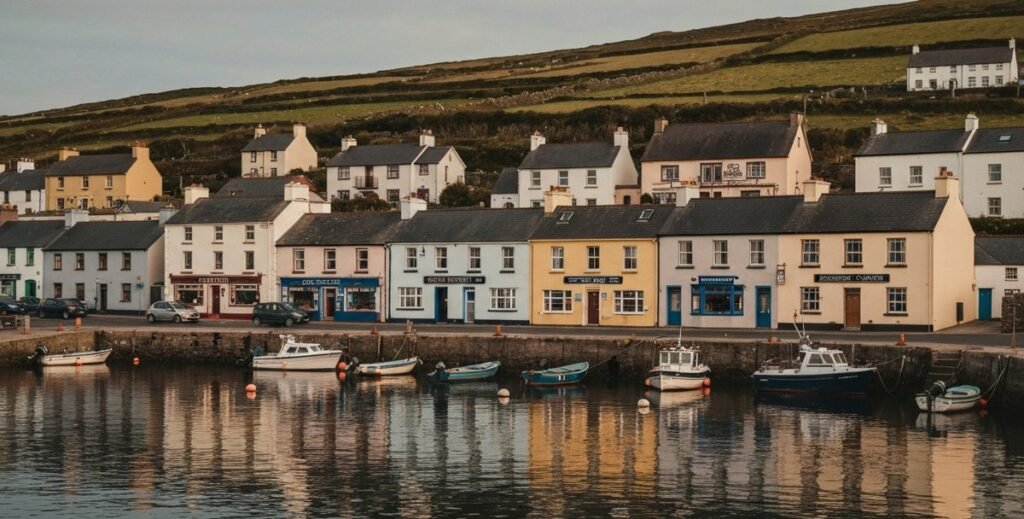
Waterville is a small seaside town facing Ballinskelligs Bay, and it has an unexpectedly famous history. Charlie Chaplin holidayed here regularly from the 1950s onwards, bringing his family back year after year. There is now a bronze statue of him on the seafront promenade. It is a good place to stretch your legs, grab a coffee and watch the Atlantic come in.
Bray Head and Skellig Michael
From Bray Head on Valentia Island — a short detour from Cahersiveen — on a clear day you can see Skellig Michael about 12km offshore. The twin-peaked island served as a Jedi training ground in the Star Wars sequel films, but its real history is more remarkable: early Christian monks built a monastery on its 218-metre summit sometime around the 6th century. UNESCO World Heritage Site, and one of the most extraordinary sights in Ireland even from a distance.
The Kerry Dark Sky Reserve
The western reaches of the ring, particularly around the Iveragh Peninsula, sit within the Kerry International Dark Sky Reserve. If you are staying overnight in Kerry rather than returning to Dublin the same day, night skies here on a clear evening are exceptional.
Ladies View
On the return leg into Killarney, the N71 passes Ladies View — a roadside viewpoint over the Upper Lake and the valley below. The name comes from Queen Victoria’s ladies-in-waiting, who reportedly admired the view during an 1861 royal visit. Worth a two-minute stop.
Daniel O’Connell’s Birthplace
Caherdaniel, a small village near the southern tip of the ring, is the birthplace of Daniel O’Connell — the 19th-century Irish political leader credited with winning Catholic Emancipation in 1829. His family home, Derrynane House, is now a museum.
Self-Drive vs Private Driver vs Bus Tour
There are three realistic ways to do a Ring of Kerry day trip from Dublin. They suit different travellers.
Self-drive gives you the most flexibility and the lowest upfront cost. The downside is the driving — roughly 7 hours of it in a single day, including roads that narrow to single track in places. Parking in Killarney and at popular stops in summer can be genuinely stressful, and you spend the return leg to Dublin tired on the motorway.
Bus tours depart from Dublin, usually running 14+ hours with a fixed schedule and fixed stops. You see the ring but on someone else’s timetable. Lunch breaks are predetermined, you cannot linger at a view you love, and you are back on the coach when the driver says so.
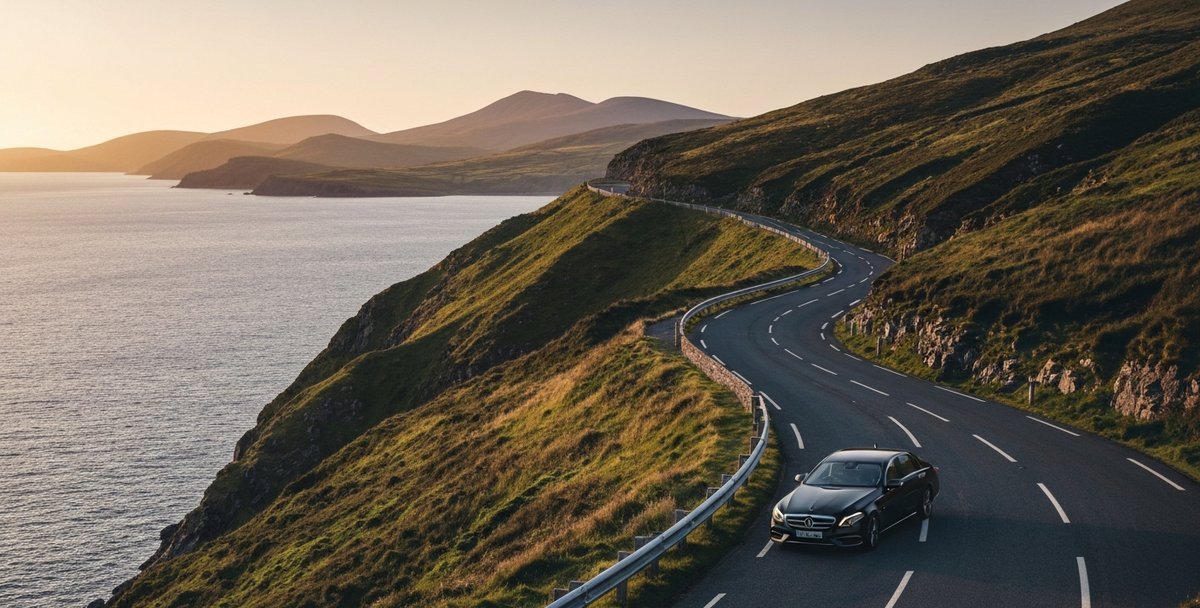
Private driver is the best option for this particular trip — not because it is the most luxurious but because the logistics genuinely justify it. Someone else handles 7 hours of driving. You can stop at an unmarked viewpoint, skip a stop that does not interest you, or take 40 minutes over lunch in Sneem. There is no parking to find, no motorway fatigue on the return, and pickup can be from your Dublin hotel, Dublin Airport, or home address. For a group of two, three or four people, the cost difference versus self-drive narrows considerably once you factor in fuel, tolls, and parking.
Skip 7 hours of driving
Our Ring of Kerry day trips include pickup and drop-off anywhere in Dublin, a licensed driver, and one fixed price — fuel, tolls and motorway fatigue not included.
Private day trip
Ring of Kerry from Dublin
Combining the Ring of Kerry with Killarney
Most day trips to the ring pass through Killarney at the start and end of the loop, and you can easily work a Killarney stop into either end of the day. The most accessible options within a short drive of Killarney town are:
- Torc Waterfall — a 20-metre waterfall a short walk from the road off the N71; takes about 25 minutes return
- Muckross House — a Victorian mansion on the shores of Muckross Lake, surrounded by formal gardens; allow 45 minutes to an hour
- Ross Castle — a 15th-century tower house on the shore of Lough Leane; about 20 minutes from town
If you want to do more than pass through Killarney, it is worth considering a two-day trip: first day Killarney National Park, second day the ring itself.
Best Time of Year for the Ring of Kerry
May and June are the sweet spot. Days are long (15+ hours of daylight in June), weather is more settled than autumn, and the summer crowds have not yet peaked. Roads are quieter than July and August.
July and August are the busiest months. The ring is heavily toured and Killarney fills quickly. Not a reason to avoid it — it is still magnificent — but expect queues at popular stops and heavier traffic on the N70.
September and October bring fewer visitors and often excellent clear days with low-angle autumn light. The risk is rain, but the ring is spectacular even in poor weather.
November to March is quiet, with short days and some facilities closed, but the light can be extraordinary and the roads are nearly empty. Worth considering if flexibility is not an issue.
Frequently Asked Questions
Is a Ring of Kerry day trip from Dublin actually possible in a single day?
Yes, but it requires an early start. Departing Dublin at 6:30am and returning by 9:30–10:00pm gives you roughly 10 hours in Kerry, which is enough to complete the ring with stops at the main villages. It is a long day — close to 860km of combined driving — so having a driver rather than doing it yourself makes a real difference to how you feel by the end of it.
How long does it take to drive the Ring of Kerry?
Without stops, the 179km loop takes about 2.5 to 3 hours. With a handful of 20–30 minute breaks at Waterville, Sneem, Kenmare and the viewpoints, allow 5 to 6 hours for the ring alone. Add your Dublin transfer times either side and you have your full day.
Which direction should I drive the Ring of Kerry?
Clockwise. This puts the ocean on your left for most of the southern and western sections, which is where the best coastal views are. It also keeps you clear of the tour coaches, which are routed counterclockwise by convention to reduce conflicts on the narrow roads.
What is the single best stop on the ring?
Waterville is many people’s answer — the combination of the beach, the village character and the clear views back across Ballinskelligs Bay is hard to beat. Kenmare, at the eastern end of the ring, is the most refined of the stops and probably the best town for lunch. If visibility is good, the detour to Bray Head for a view of Skellig Michael is something you will not forget.
Can I combine the Ring of Kerry with a Killarney sightseeing day?
Not comfortably in a single day from Dublin. The ring alone fills a full day from Dublin. If you want to spend meaningful time in Killarney National Park — Muckross House, the lakes, Ross Castle — add a night in Killarney and split the two across two days.
What is the best time of year to visit?
May and June are ideal: long daylight hours, relatively settled weather and smaller crowds than the peak summer months. September is also excellent for clear skies and quieter roads. July and August are busy but the ring is still very much worth doing.
What should I pack for a Ring of Kerry day trip?
Layers — Kerry weather changes quickly, and even a warm Dublin morning can mean a cool Atlantic wind on the ring. A waterproof jacket, good walking shoes for the stops, water and snacks for between villages, and a fully charged phone or camera. Sunglasses are useful in any season; the light off the Atlantic can be very bright on clear days.
Ready to book?
Pre-book your Ring of Kerry day trip from Dublin. We confirm within a few hours and send all the details directly.