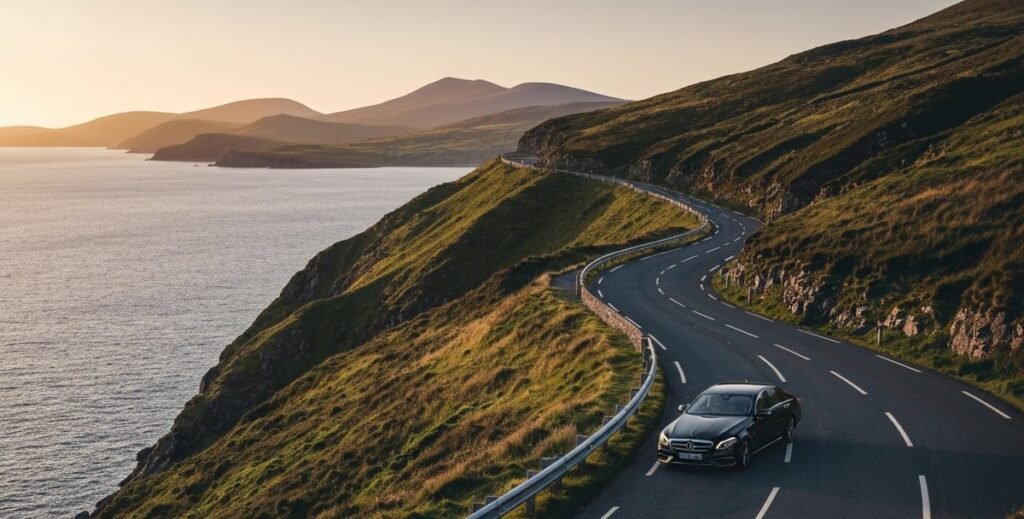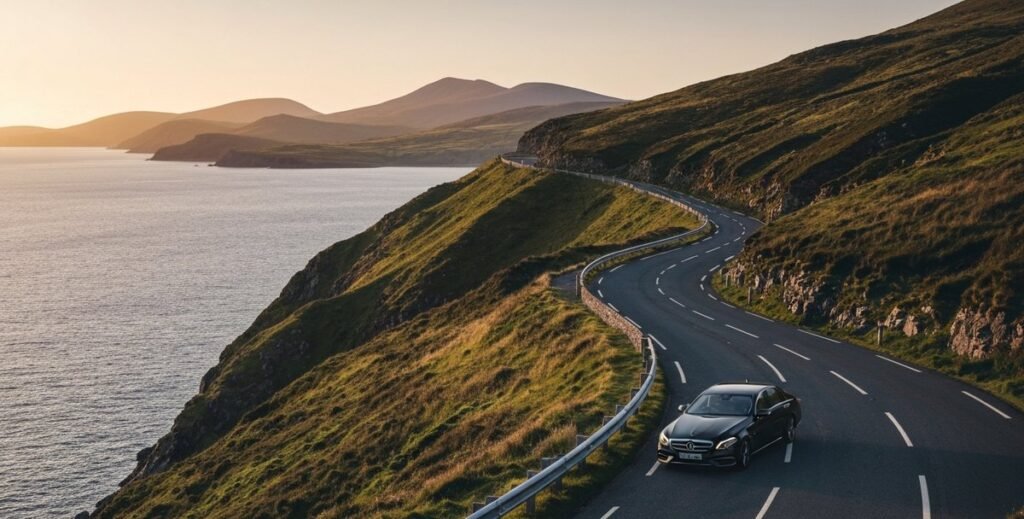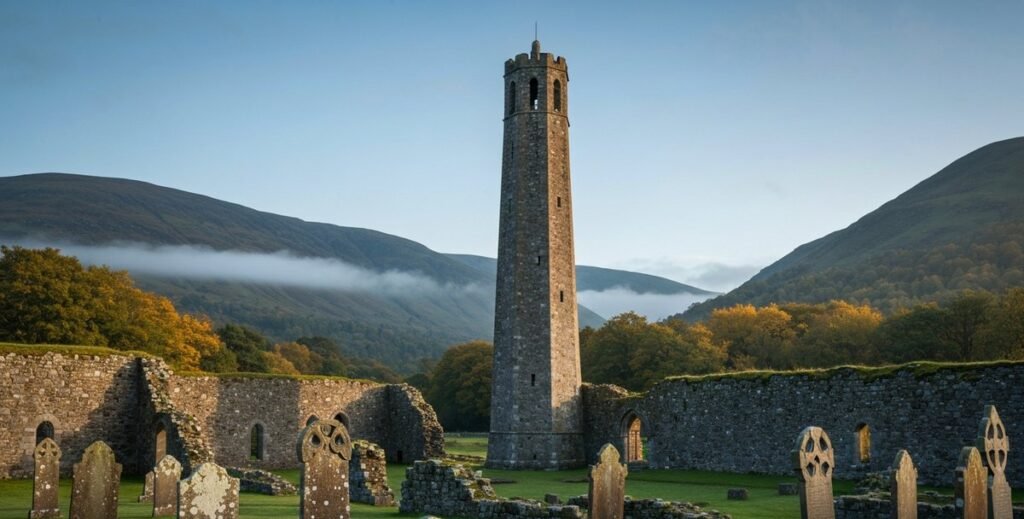
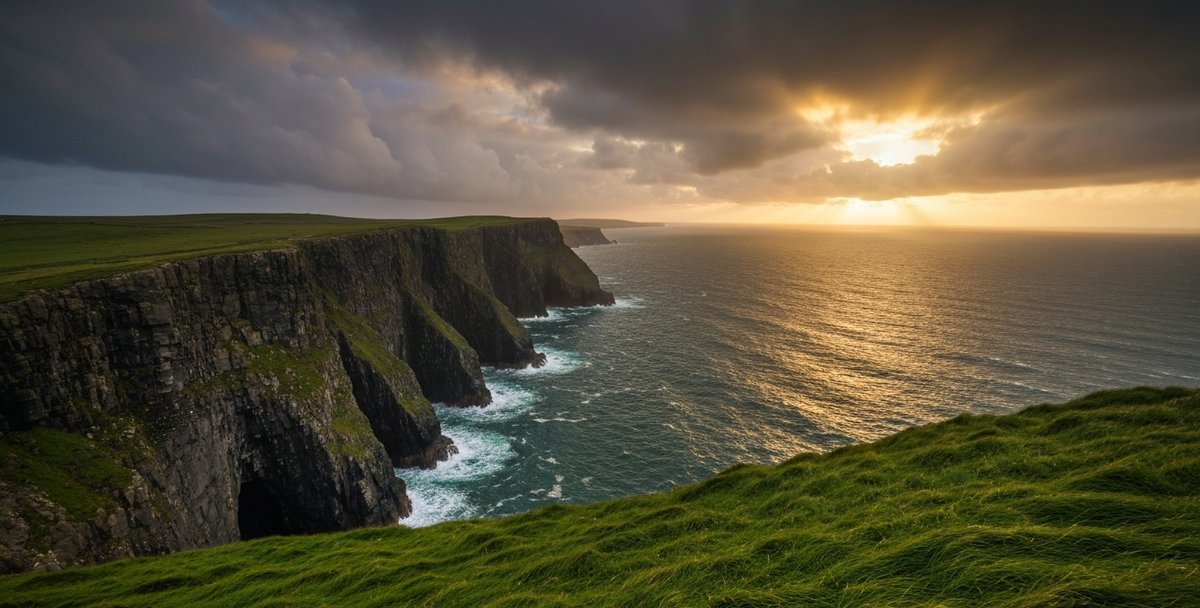
The Wild Atlantic Way is one of Europe’s longest defined coastal routes — 2,500km of Irish Atlantic coastline running from Malin Head in Donegal, Ireland’s most northerly point, all the way south to Mizen Head in Cork. Fáilte Ireland launched it in 2014, and it spans nine counties, taking in sea cliffs, hidden beaches, stone-walled farmland, fjords and some of the quietest stretches of road you’ll find anywhere on the island.
That scale is the first thing worth being honest about. You cannot do the Wild Atlantic Way in a day, or a weekend. A proper end-to-end drive takes 7 to 10 days at a reasonable pace, more if you want to stop at any of its 157 Discovery Points rather than blasting past them. Most visitors — especially those based in Dublin or arriving through Dublin Airport — have two or three days at most, and that’s fine. You don’t need to drive the whole thing to get something out of it.
What a private driver changes is flexibility. You’re not renting a car and working out unfamiliar left-hand driving on Atlantic coastal roads with no shoulder. You’re not tied to coach tour timetables that drop you at the Cliffs of Moher for 45 minutes and turn around. You travel at your own speed, stop where you want, and someone else handles the 280km each way while you look out the window at the Atlantic.
This article covers the four sections of the Wild Atlantic Way most accessible from Dublin for a day trip or short multi-day transfer, what’s actually worth seeing in each, and how to think about planning the logistics.
How the Wild Atlantic Way Actually Works
Fáilte Ireland didn’t build a road — the WAW is a mapped route along existing roads, signed with distinctive blue waymarkers and a wave logo. The Discovery Points system marks viewpoints, towns and natural features along the route, ranging from major landmarks like the Cliffs of Moher to small pull-ins that exist purely to let you look at the sea.
The route is divided into nine sections, from the Inishowen Peninsula in the north through Connacht and down into Munster. Each section has its own character: the Inishowen and Donegal coast is wild and relatively undiscovered; Connemara is dramatic and well-known; the Burren and Clare coast have an almost lunar landscape behind the sea cliffs; Kerry offers the Dingle and Iveragh peninsulas, which draw most of the international visitors.
From Dublin, you’re roughly in the middle of the island, and the Atlantic is 2.5 to 3.5 hours west depending on which section you’re targeting. That gives you workable day-trip distances to four main sections.
The Four Best Wild Atlantic Way Sections from Dublin
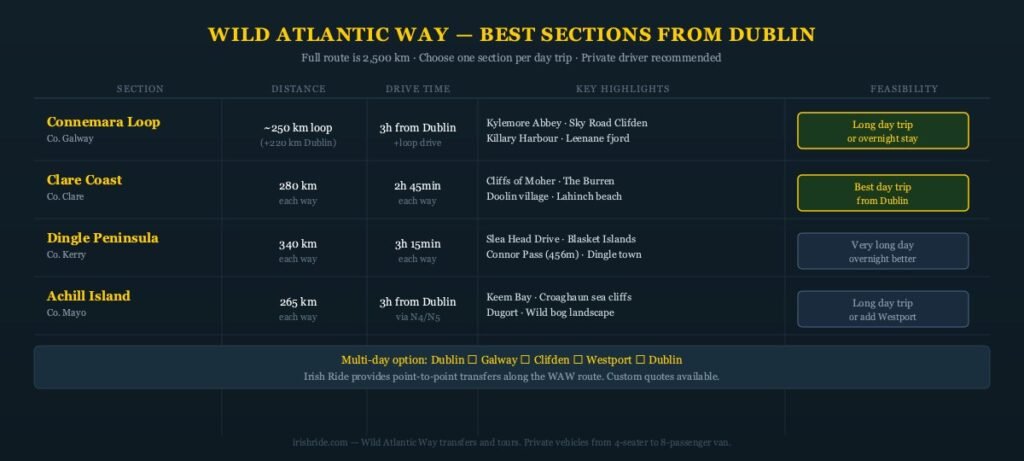
Here’s a practical comparison. All drive times are approximate from central Dublin without factoring in stops.
| Section | Distance from Dublin | Drive Time (one way) | Key Highlights | Irish Ride Day Trip |
|---|---|---|---|---|
| Connemara Loop | ~210km to Galway, then 90km to Clifden | 2h 30min + 1h 30min | Sky Road, Kylemore Abbey, Killary Harbour fjord, Leenane | Yes — full day, early start |
| Clare Coast | ~250km | 2h 45min | Cliffs of Moher, The Burren, Doolin village | Yes — efficient day trip |
| Dingle Peninsula | ~310km | 3h 20min | Slea Head Drive, Connor Pass, Dingle town, Blasket viewpoints | Yes — long day or overnight |
| Achill Island | ~265km | 3h | Keem Bay, Croaghaun sea cliffs, Dugort, Atlantic Drive | Yes — full day with vehicle swap if needed |
Section 1: Connemara — Sky Road, Kylemore Abbey and Ireland’s Only Fjord
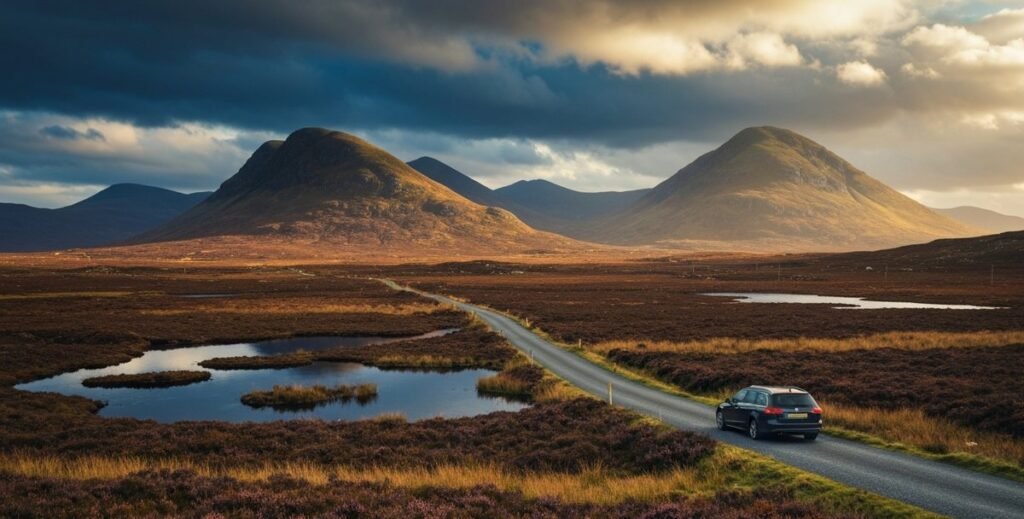
Connemara sits in County Galway, roughly 3.5 hours from Dublin if you include the drive west from Galway city to Clifden. It’s the section most often described as quintessential Ireland — low mountains, bog, Atlantic light and a coast that breaks into dozens of small inlets and islands.
The loop that makes the most sense on a day trip starts in Clifden, takes in Sky Road (a 16km coastal loop above the town with Atlantic views in three directions), then heads east through the Connemara National Park to Kylemore Abbey. Kylemore is a Victorian castle built against the Twelve Bens mountain range beside a lake — it photographs in a way that looks almost fabricated. The abbey inside is run by Benedictine nuns and the walled garden is restored to its original Victorian layout.
From Kylemore, the route south to Leenane takes you along the shore of Killary Harbour, Ireland’s only fjord. It’s 16km long, carves 45 metres deep and is genuinely fjord-shaped — steep hillsides running straight into dark water. Most coach tours skip this entirely.
A private driver can cover the Connemara loop as a full day from Dublin, leaving early morning and returning by 9 or 10pm. It’s a long day but entirely doable in summer with the light lasting until past 10pm. Alternatively, Irish Ride can drop you in Galway or Clifden and continue the next morning, making it the first leg of a multi-day transfer west.
Section 2: The Clare Coast — Cliffs of Moher and the Burren
The Clare coast is the most visited section of the Wild Atlantic Way and the most straightforward to reach from Dublin. The M18 motorway takes you to Ennis in under 2.5 hours; from there it’s another 30 minutes to the Cliffs of Moher.
The cliffs are real, and they’re worth seeing despite the crowds at the visitor centre. At their tallest they reach 214 metres above the Atlantic, stretching 14km along the coast. The O’Brien’s Tower viewpoint is where most people stop; if you walk north along the coastal path for 20 minutes you’ll lose most of the crowds and get better views back towards the main cliff face.
What most visitors don’t factor in is the Burren directly behind the cliffs. It’s a limestone karst plateau the size of a small county — flat, pale grey, cracked into pavements where Mediterranean and Arctic plant species grow side by side. It looks like nothing else in Ireland. The Burren’s interior villages, the Portal Tombs (Poulnabrone is 5,000 years old and sits open in the middle of a field), and the coast road through Doolin to Lisdoonvarna make for a day that’s more varied than just the cliffs alone.
This is one of the tighter day trips from Dublin. Leave by 7:30am, spend 2 hours at the cliffs, a couple of hours in the Burren, stop in Doolin for lunch, and you’re back in Dublin by 9pm. Irish Ride regularly runs this as a single-day transfer or tour.
Section 3: The Dingle Peninsula — Connor Pass and Slea Head Drive
The Dingle Peninsula in Kerry is 310km from Dublin — a 3h 20min drive on a good run. That makes it a long day trip or a more comfortable multi-day itinerary, particularly if you’re combining it with the Killarney area or continuing south to Cork.
Dingle town itself is small — about 1,800 people — with a working fishing harbour, good seafood restaurants and a dolphin named Fungie who disappeared in 2020 after 37 years living in the bay. The town is manageable on foot and doesn’t overwhelm.
The Slea Head Drive is a 47km loop around the tip of the peninsula, and it’s the best single loop drive on the entire Wild Atlantic Way. It takes in the Blasket Islands viewpoint (the westernmost inhabited islands in Europe before they were evacuated in 1953), Bronze Age beehive huts, the hillside village of Ventry, and a coastline that on a clear day looks straight out across the North Atlantic to nothing until North America.
Connor Pass sits above all of it — at 456 metres it’s the highest mountain pass in Ireland, with views down both coasts of the peninsula on a clear day. The road narrows to single-track at the top and requires careful driving; it’s one of those stretches where having a driver who knows the road makes a practical difference.
For a long day trip, Irish Ride can get you out and back in a day if you leave by 7am. More comfortably, a two-day arrangement where the driver drops you in Dingle in the afternoon, you stay overnight, and the circuit continues the next morning is worth the extra cost.
Section 4: Achill Island — Sea Cliffs, Keem Bay and the Atlantic Drive
Achill Island sits off the Mayo coast, connected to the mainland by a short bridge, and it’s less visited than Connemara or Kerry despite having some of the most dramatic scenery on the route. The island has a year-round population of around 2,500 people and very little tourist infrastructure — which is most of the appeal.
Croaghaun on Achill’s western edge has sea cliffs that drop 688 metres to the Atlantic, making them the highest sea cliffs in Ireland. They’re technically taller than Slieve League in Donegal (which is usually marketed as the highest in Ireland or Europe depending on which tourist board you’re reading), and because they’re on a remote headland requiring a walk to reach them, you’re unlikely to share them with many people.
Keem Bay is a horseshoe cove in the shadow of Croaghaun — the kind of beach that looks tropical in summer photographs and genuinely bleached white. The water is cold. The Atlantic Drive along Achill’s southern coast winds through moorland above the sea and is one of those drives that rewards going slowly.
At 265km from Dublin, Achill is a 3-hour drive each way. It works as a full day; Irish Ride can also build it into a multi-day itinerary with a Westport or Castlebar overnight.
Planning a Multi-Day Wild Atlantic Way Transfer
One thing Irish Ride does that coach tours cannot is point-to-point transfer along the WAW over multiple days. A practical two or three-day route from Dublin might go: Dublin → Galway (overnight) → Clifden and Connemara loop → Westport (overnight) → Achill Island → back to Dublin. That covers the two best sections in the north of the route at a reasonable pace, with time to actually stop rather than photograph from a window.
A four-day version could extend south: Dublin → Limerick → Cliffs of Moher and the Burren → Dingle (overnight) → Slea Head Drive → Killarney → back to Dublin. All of those legs are manageable distances, and the vehicle stays consistent — no dragging luggage between hire companies or worrying about dropping a rental car in the wrong city.
Vehicle options with Irish Ride range from a standard 4-seater saloon up to an 8-passenger van, which makes the multi-day format practical for families or small groups. Pricing is based on a custom quote that factors in the route, dates and vehicle.
Get a quote or check availability at irishride.com/service/wild-atlantic-way/.
Best Time of Year to Drive the Wild Atlantic Way
The Wild Atlantic Way is accessible year-round, but the experience varies considerably by season.
June to August is peak season. The light is exceptional — long summer evenings mean you can be out until 10pm and still have usable light. The cliffs, bays and beaches are at their best. Accommodation is harder to find and more expensive, particularly in Dingle and Clifden.
May and September are arguably the best months. Crowds are noticeably thinner than summer, the weather is still reasonable, and prices drop. Wildflowers are at their best in May; September light has a quality that’s harder to find in midsummer.
October to March is quiet, sometimes very quiet. The coastal roads can be beautiful in winter light and you’ll have viewpoints largely to yourself. Atlantic storms make driving and walking plans unreliable, and some smaller businesses close for the season. If you’re flexible on timing and prepared for weather, winter on the WAW can be memorable.
Avoid bank holiday weekends in any season if you want to park near the Cliffs of Moher without planning around it.
Frequently Asked Questions
Can you do the Wild Atlantic Way as a day trip?
You can do a section of it as a day trip, yes. The full 2,500km route takes 7 to 10 days minimum. From Dublin, the Clare coast (Cliffs of Moher and Burren) is the tightest workable day trip at around 2h 45min each way. Connemara and Achill are full long days. Dingle is better as an overnight or two-day trip. A private driver makes day trips more practical because you’re not dealing with an unfamiliar hire car on narrow coastal roads after a long drive.
How long does the Wild Atlantic Way take?
End to end at a reasonable pace — stopping at key points, eating, sleeping in different towns — most people allow 7 to 10 days. If you’re driving fast and skipping stops you could technically do it in 4 to 5 days, but you’d miss most of what makes it worth doing. From Dublin, a targeted 2 to 3 day trip covering one or two sections is the realistic format for most visitors.
What’s the best section of the Wild Atlantic Way near Dublin?
The Clare coast (Cliffs of Moher, Burren, Doolin) is the closest and most accessible at roughly 2h 45min from Dublin. It’s the most visited section for good reason. If you want something less crowded, Connemara is slightly further but the Killary Harbour fjord and Kylemore Abbey route offers more variety than a single major landmark.
What’s the best time of year to visit?
May and September offer the best balance of weather, light and manageable crowds. June to August has the longest days but peak-season traffic and accommodation costs. Winter is atmospheric but unpredictable with Atlantic weather.
What’s the difference between driving the Wild Atlantic Way yourself and hiring a private driver?
The practical difference: left-hand traffic on narrow single-track roads in an unfamiliar hire car, including mountain passes like Connor Pass and coastal cliff roads, is genuinely more demanding than driving at home. A private driver knows the roads, handles the logistics, and means you can look at the scenery rather than focusing on the wing mirrors. For groups of three or more, a private vehicle often comes close to the cost of hiring a car once you factor in fuel and insurance.
Do I need a car to do the Wild Atlantic Way?
You need some form of private transport. There’s no bus or rail service that follows the WAW route, and the Discovery Points — by design — are mostly only reachable by road. Cycling is possible and popular on some sections, but the distances make it a dedicated multi-week trip. A hire car or private driver are the practical options for most visitors.
Can a private driver do multi-day Wild Atlantic Way trips?
Yes. Irish Ride does point-to-point transfers along the WAW covering multiple sections over two or more days, with flexible routing based on what you want to see. The vehicle stays consistent, the driver knows the roads, and the itinerary can be built around your accommodation. Quote and availability at irishride.com/service/wild-atlantic-way/.