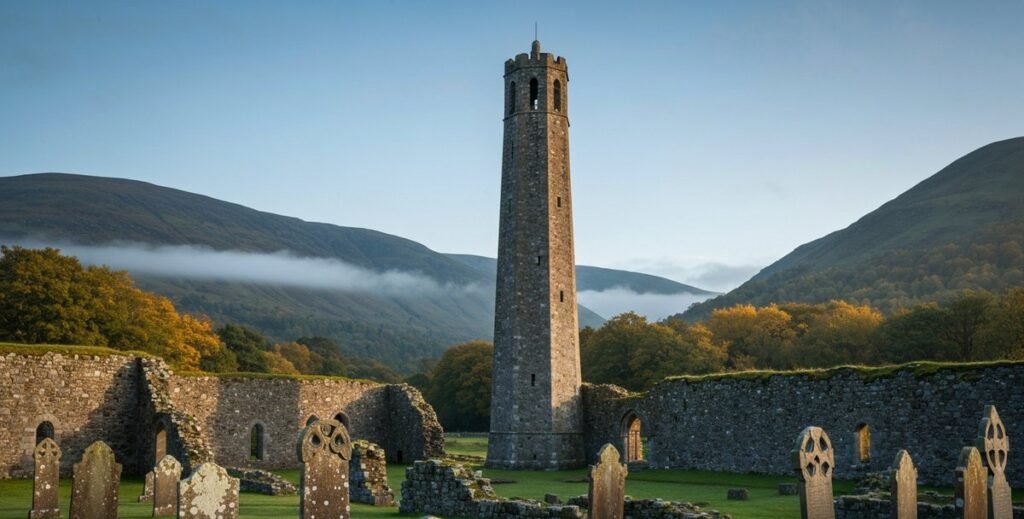
Balbriggan is a coastal town in north County Dublin, about 32km north of Dublin Airport, best known locally for its beach, its working fishing harbour, and a Martello Tower left over from the Napoleonic-era defences along this stretch of coast. It’s also one of the fastest-growing towns in Ireland — the population roughly tripled between 1991 and 2022 — which means there’s a genuine gap between what people expect of a small seaside town and what’s actually there now: new estates, a busy Friday market, and a €15 million harbour redevelopment reshaping the waterfront.
This guide covers what’s worth seeing, how the town has changed, and the practical side of getting there — by road, by rail, or with a private driver. If you’re looking to book a local taxi in Balbriggan itself rather than plan a visit, our Taxi Balbriggan page covers that directly.
Getting to Balbriggan
By road from Dublin Airport: About 32km via the M1, roughly 30 minutes in normal traffic.
By rail: Balbriggan railway station sits on the Dublin–Belfast line and is currently served by the Northern Commuter service, with trains to Dublin Connolly and on to Grand Canal Dock. New battery-electric DART+ trains began rolling out on this line through 2026, cutting reliance on the older diesel fleet — full DART electrification (the overhead-wire infrastructure extending the network from Malahide to Drogheda) is a separate, longer-term project still years from completion, so don’t expect a traditional DART service just yet, even though the trains themselves are newer.
By private driver: For an airport arrival, a family visit, or a group without easy access to the train, a pre-booked fixed-fare transfer avoids the connection into the city centre that the train otherwise requires. See Taxi Balbriggan for local service details and coverage areas.
What’s Worth Seeing
Balbriggan Beach sits close to the town centre and has been a local favourite for generations — sweeping views across the Irish Sea, and a genuinely lively spot in summer when families picnic and children paddle in the shallows.
The harbour is a working fishing harbour, and it’s mid-redevelopment: a €15 million project launched in 2024 is turning the waterfront into a multi-purpose plaza and linear park, with the old RNLI boathouse being converted into a visitor centre. It’s worth checking current completion status before planning a visit specifically around it, since the scheme was still finishing out as of the most recent reporting.
The Martello Tower at the northern end of the beach is one of the string of coastal defence towers built in the early 1800s against the threat of a Napoleonic invasion — a recognisable landmark rather than a formal visitor attraction, but worth knowing what you’re looking at.
Ardgillan Castle and Gardens, on the outskirts of town, is the standout attraction nearby: 194 acres of parkland overlooking the Irish Sea, with a restored walled garden dating in part to the 18th century (the central block was built in 1738) and Victorian glasshouses. Free to walk the grounds; the castle itself and gardens have their own opening hours worth checking in advance.
The Friday market, running from 10am in the town centre, is a genuine local institution — seafood, produce, crafts and street food, not a tourist-oriented event but a real weekly market worth timing a visit around if your schedule allows.
A Town That’s Changed Fast
Balbriggan’s growth is worth knowing about if you haven’t visited in a few years. Census figures put the population at 21,722 in 2016 and 24,322 by 2022 — a rise of around 12% in six years that made it the 17th largest urban area in the country. Go back to 1991 and the town had just 7,724 people, so today’s population is more than three times that. New estates have gone up through the 2000s, 2010s and into the 2026 building cycle on the town’s western and southern fringes, and that growth shows no sign of slowing.
Frequently Asked Questions
How far is Balbriggan from Dublin Airport?
About 32km via the M1, roughly 30 minutes by car in normal traffic.
Can I get to Balbriggan by train?
Yes — Balbriggan railway station is on the Dublin–Belfast line, served by Northern Commuter trains to Dublin Connolly and Grand Canal Dock. New battery-electric DART+ trains started serving the route through 2026, though full DART electrification to Drogheda is a separate project still years away.
Is Balbriggan Beach worth visiting?
Yes, particularly in summer — it’s a genuine local beach with sea views across to the Irish Sea, close to the town centre, and a lively spot for families rather than a quiet, empty stretch of sand.
What’s the best nearby attraction to combine with a Balbriggan visit?
Ardgillan Castle and Gardens, a few minutes outside town — 194 acres of parkland, a restored walled garden and Victorian glasshouses, with the castle building itself dating to 1738.
Is there a taxi service in Balbriggan?
Yes — see our dedicated Taxi Balbriggan page for local coverage, including the surrounding villages of Balrothery, Gormanston and Stamullin.
How much has Balbriggan grown?
Substantially — from 7,724 people in 1991 to 24,322 by 2022, making it the 17th largest urban area in Ireland. New housing developments continue on the town’s fringes.